
September 16, 2016
A landmark event focusing on the impact of explosive devices internationally has called for governments to muster the political will to address the threat that Improvised Explosive Devices (IEDs) pose to civilians.
Roger Mullin MP, the outgoing Chair of the All Party Parliamentary Group on Explosive Weapons, made the point at a conference in the House of Commons yesterday (Thursday 15th of September) where international experts in the field met to discuss the findings of a major inquiry.
“Fundamentally, to counter the threat of IEDs and to defeat these devices, political will is needed. Governments around the world can make it happen.”
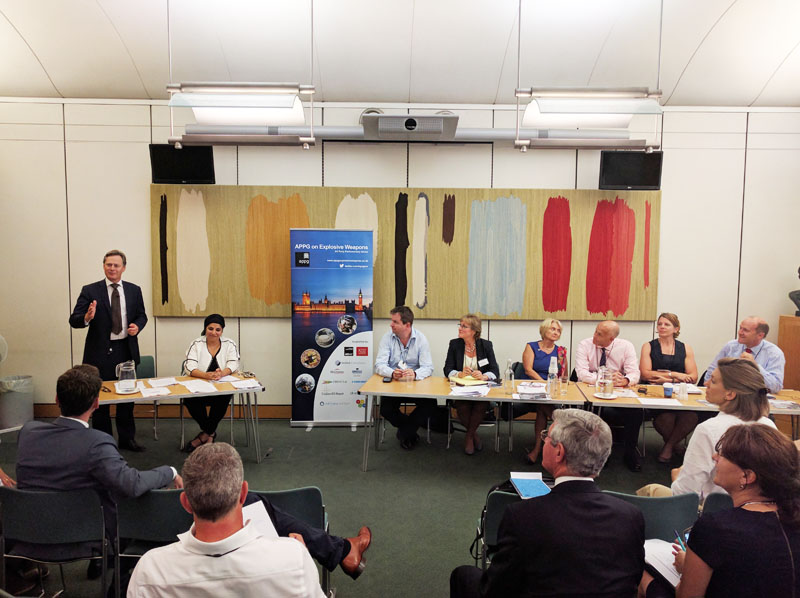
Panellists at the event included
- Agnès Marcaillou, Director, United Nations Mine Action Service
- Hannah Bryce, Manager International Security, Chatham House
- Dr Laura Cleary, Head of the Centre for International Security & Resilience and a Senior Lecturer in International Relations, Cranfield University
- Iain Overton, CEO, Action on Armed Violence
- Maj. Gen Jonathan Shaw, Chairman, Optima Group
- Brig Gareth Collett, Defence Attache, British Embassy in Iraq
IEDs are becoming a globally recognised threat, and their devastating impacts on communities have increased year on year. In 2015, Action on Armed Violence recorded 43,786 total deaths and casualties as a result of explosive weapons. Of these, 33,307 - 76% - were civilians. This represents a 2% global increase in civilian deaths and injuries from explosive weapon use from 2014 data and 54% more than in 2011, with incidents in 64 countries worldwide – more countries than reported in any of the last five years, with spikes in Syria and Ukraine. The impact of IEDs stretches far beyond civilian casualties - it has never been more dangerous to work in the field of aid due to the increase in IEDs.
In places like Iraq, until these explosives have been cleared, displaced people cannot return safely to their homes, languish in camps or overcrowded housing, or join the exodus to Europe and delay the country’s return to normal life. The scale of the challenge is immense – Brig Gareth Collet suggested that it might take up to 30 years to completely eliminate the threat there.
Rising to this challenge quickly enough to contain the social and political pressures created over 3.3 million Iraqis being displaced requires a coordinated team effort.
The international community must take a coordinated approach, according to Agnès Marcaillou. “The United Kingdom was a champion on the UN Security Council for pushing for the words ‘international coordination’ in the Security Council’s resolution on Libya. Greater coherence for greater impact of action is essential. This forward thinking is crucial in how we approach IEDs, as well.”
Coordination between governments and the private sector is crucial too. “Private sector expertise has a crucial role to play in ensuring the capacity exists internationally to defeat IEDS”, said Maj Gen Jonathan Shaw. “But, neither the military or private sector alone have the full answer. Coordination and cooperation at all levels is crucial.”
“To do this, we need multi-year reliable funding,” said Marcaillou. “But funding must be managed well, in full transparency with accountability and with proper oversight. It is the responsibility of parliamentarians to establish priorities and fulfil this role.”


